INU Professor Jin-ho Lee’s Research Team Proposes Design, Patterning, and AI-Based Strategies to Bridge the Cell-to-Module Gap in Organic and Perovskite Solar Cells
- 글번호
- 423200
- 작성일
- 2026-04-22
- 수정일
- 2026-04-22
- 작성자
- 홍보과 (032-835-9490)
- 조회수
- 428
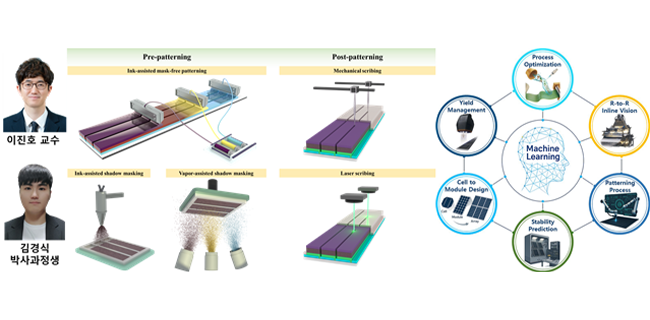
From left: Professor Jin-ho Lee and Kyung-sik Kim (Ph.D. candidate) who conducted the research. (Center) Schematic of pre-patterning and post-patterning processes for organic and perovskite solar cell modules. (Right) AI/machine learning-based integrated workflow for module design and process optimization
Incheon National University (President: In-jae Lee) announced that a research team led by Professor Jin-ho Lee of the Department of Physics has published a comprehensive study on module design and patterning technologies for large-area organic and perovskite solar cells.
The study was published online on March 19 in Energy & Environmental Science (Impact Factor: 31, top 0.4% in JCR), one of the world’s most prestigious journals in the energy and environmental field. The research was conducted in collaboration with Dr. Nam-jung Jeon and Dr. Soon-il Hong from the Korea Research Institute of Chemical Technology (Article title: Review of module designs for organic and perovskite solar cells).
Currently, organic and perovskite solar cells have achieved high efficiencies of 19.2% and 27.0%, respectively, at the small-area laboratory scale. However, when scaled up to large-area modules (>10 cm²) for commercialization, efficiency drops sharply by 20–30%, creating a major bottleneck known as the “cell-to-module gap.” Professor Lee’s team systematically analyzed the essential module architecture design and precision patterning technologies required to overcome this challenge.
In particular, the team conducted an in-depth analysis of laser scribing, the most widely used patterning technique. While laser scribing enables a high geometric fill factor (GFF) of over 95% through a non-contact process, it also introduces performance degradation due to the heat-affected zone (HAZ) generated during processing. To address this, the researchers proposed innovative alternatives, including ultrafast laser processing, “P2-free” self-aligned structures that fundamentally eliminate thermal damage, and in-situ electrochemical patterning techniques.
The study also places strong emphasis on integrating artificial intelligence (AI) and machine learning into solar cell manufacturing. By leveraging AI to screen vast combinations of materials and optimize complex process variables, the research presents a vision for a smart manufacturing platform capable of simultaneously enhancing efficiency and stability in next-generation solar cells.
Professor Jin-ho Lee stated, “This paper provides a clear roadmap for overcoming the critical challenge of ‘scaling up’—a barrier that must be addressed for next-generation solar cells to move beyond the laboratory and become practical energy sources in everyday life.” He added, “In particular, the convergence with AI technology will be a key driver in maximizing manufacturing efficiency and reshaping the future solar energy market.”
This research was supported by the Mid-Career Researcher Program of the National Research Foundation of Korea under the Ministry of Science and ICT, and the Energy Human Resource Development Program of the Korea Institute of Energy Technology Evaluation and Planning (KETEP) under the Ministry of Trade, Industry and Energy.