The Era of Invisible Batteries Begins: INU Professor Jun-dong Kim’s Team Presents Next-Generation Transparent Energy Storage Technology
- 글번호
- 423199
- 작성일
- 2026-04-22
- 수정일
- 2026-04-22
- 작성자
- 홍보과 (032-835-9490)
- 조회수
- 417

From left: Jun-dong Kim (Professor, Department of Electrical Engineering) and Ju-hyung Yoon (Professor, Department of Electrical Engineering)
Incheon National University (President: In-jae Lee) announced on the 6th that a research team led by Professor Jun-dong Kim from the Department of Electrical Engineering, College of Engineering (Dean: Jun-dong Kim), has presented transparent battery technology, proposing new directions for energy utilization.
“Transparent batteries,” which have the potential to transform next-generation electronic devices, are rapidly advancing. They are expected to play a key role in future technologies such as smart windows, wearable devices, and transparent displays, and are gaining attention as an innovative energy storage solution that overcomes the limitations of conventional opaque batteries.
A transparent battery is a device capable of storing energy while allowing light to pass through. To be considered practically “transparent,” it must typically achieve a light transmittance of over 50–80% in the visible spectrum (400–700 nm). This requirement goes beyond design considerations and is essential for devices that must maintain optical functionality, such as cameras, sensors, and medical instruments.
Professor Ju-hyung Yoon, who participated in the study, explained that the research focuses on developing energy conversion and storage technology using cobalt pyrite thin-film 2D materials, and predicted that future technologies will be fundamentally based on “invisible, smart energy systems.”
For commercialization, a fundamental challenge remains in balancing transparency and energy density. Increasing transparency by reducing active materials inevitably leads to a decrease in storage capacity, presenting a structural limitation.
To address this issue, the research team is exploring various approaches, including nanostructure design, ultrathin electrodes, and patterned electrode arrays. In addition, active research is underway to integrate transparent batteries with transparent solar cells, aiming to realize self-charging energy systems.
Professor Jun-dong Kim stated, “Energy storage devices, including transparent batteries, will go beyond mere design innovation and become ‘invisible power sources’ that fundamentally change the structure of electronic devices.” He added that the team is preparing technologies to create new large-scale markets in areas such as smart windows, augmented reality (AR) devices, and medical sensors.
The research findings were recently published as a review article titled “Extensive Review of Materials for Next-Generation Transparent Batteries and Their Design Strategies” in the latest issue of Advanced Functional Materials, attracting significant attention as a new approach to energy utilization.
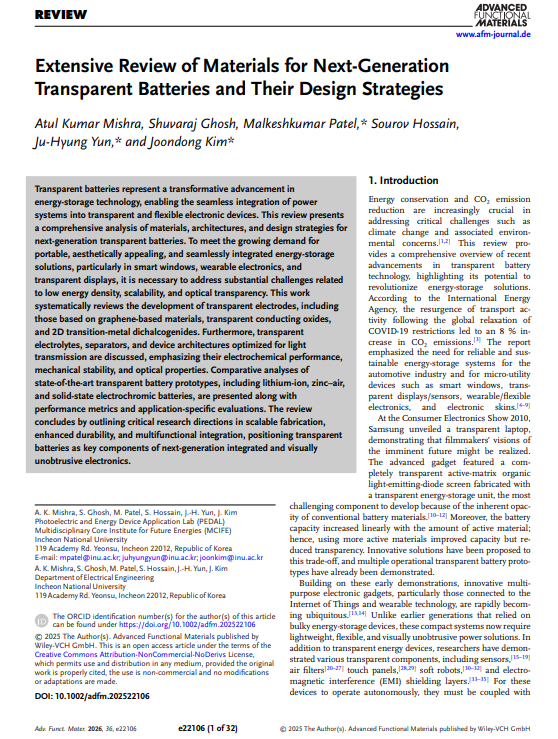

Research Materials
- 첨부파일
-
- INU Professor Jun-dong Kim’s Team Presents Next-Generation Transparent Energy Storage Technology 3.png
- INU Professor Jun-dong Kim’s Team Presents Next-Generation Transparent Energy Storage Technology.png
- INU Professor Jun-dong Kim’s Team Presents Next-Generation Transparent Energy Storage Technology 4.png